Showing posts with label Cambodiannews. Show all posts

Power plan farce

Written By dav on Monday, June 20, 2011 | 5:50 AM

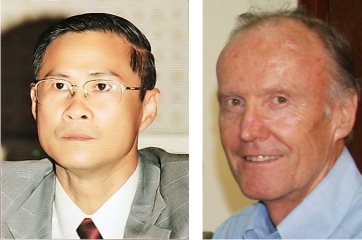
Choeung Sopheap (L) is the wife of Lao Meng Khin (R). Both are Hun Xen's cronies and land-thieves
Friday, 17 June 2011
Thomas Miller and Vong Sokheng
The Phnom Penh Post
How could we ensure … a distinction between the power of the legislative branch and the business sector?” he said. “Let the people examine this process as well …. We don’t want this project to be repeated like at Boeung Kak lake.”
The National Assembly voted without debate yesterday to guarantee perhaps millions of dollars in payments for electricity from a power plant being built by a company owned by ruling party Senator Lao Meng Khin.

Government officials praised the project yesterday, which has come under criticism for its lack of transparency and its connection with the controversial senator, saying it would provide the Kingdom with much-needed electricity and jobs while having a minimal impact on the environment.

But opposition lawmakers walked out in protest amid lingering questions about how the concession was awarded and whether the electricity will be priced fairly. Sam Rainsy Party parliamentarian Mu Sochua posed numerous questions about the Preah Sihanouk province project during the brief hearing to National Assembly President Heng Samrin, who refused to answer or provide time for debate.

“We walked out because I asked all these questions… and then he didn’t answer anything – did not allow any discussion at all,” Mu Sochua said yesterday.

She said the prospect of holding a proper debate was “too hot” for the ruling party.


“This [decision] does not reflect a parliament that is independent, that is neutral,” Mu Sochua said.

Minister of Economy and Finance Keat Chhon expressed gratitude to the lawmakers who supported the measure and criticised the opposition for seeking further debate. He added that the government could have responded to the questions raised, but said it would have been “a waste of time”.

The Ministry of Economy and Finance had asked the National Assembly to guarantee any debts owed to Lao Meng Khin’s firm by state power company Electricité du Cambodge.

The senator’s company, Cambodia International Investment Development Group Co Ltd, earned Hun Sen’s approval in December for a joint venture with a Chinese firm to construct and operate the US$362 million plant. CIIDG subsequently entered into a power-purchase agreement with Electricité du Cambodge in January.

Lao Meng Khin also heads Shukaku Inc, which is developing the Boeung Kak lakeside in a joint venture with a Chinese firm. The project has drawn widespread condemnation for its expected displacement of more than 4,000 families who so far have not received proper compensation.

Mu Sochua, who told The Post on Wednesday that lawmakers had been given minimal information about the plant, said in parliament yesterday that the measure before lawmakers should be opposed because of the company’s connection to abuses at the lakeside and the opaque nature of the project.

“We have to have a clear understanding of the project before we raise our hands in approval. The SRP is not in support of the company linked to the Boeung Kak project, which owes the blood of the poor,” she said.

According to documents signed by Prime Minister Hun Sen on March 16 and presented to the National Assembly yesterday, CIIDG has agreed to sell power to Elecricité du Cambodge at a cost of 8.43 cents per kilowatt hour.

The documents note, however, that fluctuation in the price of coal may alter the price of the electricity. The 270-megawatt plant is set to supply the state power company with 1.8 billion kilowatt hours per year.

CIIDG will enjoy a tax exemption for VAT and income during the first nine years of its 33-year concession. After that, the government said it expects to haul in $15 million per year in taxes, in addition to an estimated $8 million for taxes on imported coal and petroleum.

The government has also agreed to waive taxes for importing machinery, construction materials and spare parts during the first year of an expected three-year construction period.

Observers expressed concern about the proposed power plant, citing the potential environmental impacts of coal to both the air and water in the tourist hub of Sihanoukville, and stressed the need for greater transparency.

Ame Trandem, Mekong campaigner for the environmental group International Rivers, said the price of electricity in the agreement – 8.43 cents per kilowatt hour – appeared to be the “most expensive” for a project she had seen in Cambodia, citing a 2009 study by NGO Forum and Probe International that said Electricité du Cambodge was buying electricity from hydropower dams and other projects at between seven and eight cents per kilowatt hour.

Mam Sambath, chairman of local watchdog group Cambodians for Resource Revenue Transparency, said he expected the cost per kilowatt hour of 8.43 cents to rise significantly, perhaps by three or four times, when it is re-sold to consumers by Electricité du Cambodge.

I’m afraid that’s the buying price, and the selling price is more expensive,” he said.

He acknowledged the need for cheaper power for rural Cambodians, but said he was “worried” about the transparency of the project and its apparent disregard for any division between business and politics.

“How could we ensure … a distinction between the power of the legislative branch and the business sector?” he said. “Let the people examine this process as well …. We don’t want this project to be repeated like at Boeung Kak lake.
5:50 AM | 0 comments | Read More

Call for action in KRT’s 004

Andrew Cayley
Friday, 17 June 2011
James O'Toole
The Phnom Penh Post

Khmer Rouge tribunal co-prosecutor Andrew Cayley has called for additional investigation in the court’s controversial fourth case, the latest salvo in his ongoing struggle with the tribunal’s investigating judges.

In a statement issued yesterday, Cayley said he had filed a “supplementary submission” in the case that expands on the alleged crimes initially listed by the prosecution, and a related request for investigative action.

“The Supplementary Submission adds additional crimes to Case 004, including crimes committed against the Khmer Krom population in Takeo and Pursat provinces, based primarily on civil party applications, complaints and other new evidence the International Co-Prosecutor became aware of subsequent to the original filing of the Case 004 Introductory Submission,” Cayley said.


International prosecutors made this introductory submission, lacking support from their Cambodian counterparts, in 2009.

Cayley added that he planned to request that the court’s co-investigating judges, Siegfried Blunk of Germany and You Bunleng of Cambodia, “notify the public and potential civil parties of the specific crime sites that are included in both the Introductory and Supplementary Submissions in Case 004”.

The tribunal has been embroiled in controversy of late over the investigating judges’ apparent failure to properly investigate the court’s third case.

The judges concluded their investigation in April without even questioning suspects, prompting allegations that they had sabotaged the case under pressure from the Cambodian government, which opposes prosecutions beyond the upcoming Case 002.

Staff from the judges’ office have begun resigning in protest over the abortive 003 investigation, which remains officially confidential but feat-ures KR military commanders Meas Mut and Sou Met.

Case 004 involves a trio of mid-level KR officials, and analysts say it appears headed for dismissal as well.
5:48 AM | 0 comments | Read More

Clowns-In-Justice robe: Can't investigate REAL crime, but has time to pursue LEAKED documents?

CLOWNs-IN-JUSTICE ROBE No.1 and No. 2: Bandit You Bunleng and Herr Doktor Siegfried Blunk
Tribunal Judges Issue Warning to Media Over Leaks

Friday, 17 June 2011
Kong Sothanarith, VOA Khmer | Phnom Penh
“...warning is hereby given that anyone publishing information from this confidential document is liable to be subjected to proceedings for interference with the administration of justice.” (sic!)
Investigating judges at the UN-backed Khmer Rouge tribunal issued a sharp warning to media outlets on Friday, in an attempt to forbid them from printing information from confidential, leaked documents of the court.

The Christian Science Monitor and the Associated Press have provided detailed coverage of a controversial case at the court, naming two suspects judges have said should remain anonymous based on a leaked prosecution submission.

The judges, Siegfried Blunk and You Bunleng, threatened legal action against media outlets that publish or broadcast the names of the suspects. It remains unclear under what authority the court would pursue such action.

The judges said they had “credible information” the prosecution’s introductory submission had been leaked by “a disloyal staff member” of the court, and said, “warning is hereby given that anyone publishing information from this confidential document is liable to be subjected to proceedings for interference with the administration of justice” under court rules.


The investigating judges have come under increased criticism for their handling of Case 003, after they hastily concluded their investigation in April without conducting field investigations or interviewing the two chief suspects.

The court has kept the names of the suspects confidential. However, the Christian Science Monitor, citing court documents in reports on June 10 and June 15, identified them as Khmer Rouge naval commander Meas Muth and air force commander Sou Met.

The US-based paper said they were accused of “shared responsibility” for crimes including torture, murder and forced labor.

“In particular, Sou Met and Meas Mut[h] participated in a criminal plan to purge the Revolutionary Army of Kampuchea of all undesirable elements, which resulted in at least thousands and quite probably tens of thousands of deaths,” the Monitor reported, citing court documents.

Tribunal spokesman Huy Vannak said that the judges had not considered any actions yet, but that “any documents that are not issued by the court are unofficial.”

Ou Virak, head of the Cambodian Center for Human Rights, said Friday the case was already publicly known, but the naming of suspects did “touch on the rights of the accused.”
5:42 AM | 0 comments | Read More

“If neither of [the judges] can stand up, which means they can’t fulfill their job, then they should resign”: Ou Virak


Ou Virak, head of the Cambodian Center for Human Rights, told “Hello VOA” the UN must “investigate the current chaos” at the court, after judges hastily concluded an investigation into Case 003. (Photo: by Men Kimseng)


5:33 AM | 0 comments | Read More

In Thailand's 'red shirt villages', defiance ahead of election


Residents at Jessada housing estate in Ayutthaya’s Wang Noi district wear red shirts and wave red flags to declare their community a ‘‘red shirt village’’. Villagers in several provinces in the Northeast have also proclaimed their communities as red shirt villages. SUNTHORN PONGPAO, Bangkok Post
Tue Jun 7, 2011
NONG HU LING, Thailand (Reuters) - By Jason Szep and Ambika Ahuja

Its brilliant green rice paddies, thatched-roof huts and overgrown jungle resemble most rural villages in northeast Thailand. But the red sign looming over a quiet dusty road in the community of Nong Hu Ling is something different.

"Red Shirt Village for Democracy," it reads, proclaiming its allegiance to the red-shirted, anti-government movement whose protests paralysed Bangkok last year and sparked a bloody military crackdown that ended with 91 people killed and hundreds of activists arrested.
5:25 AM | 0 comments | Read More

China's no to signing water sharing pact imperils India

NEW DELHI: The recent scare about China diverting the course of the Brahmaputra River is not the first time that India has expressed concerns about its Communist neighbour's hydel projects, and is unlikely to be the last.

Beijing not only has a host of projects lined up on the Brahmaputra River — 24 according to some reports — but has also planned at least five, which have a cumulative power generation capacity of about 2,000 mw, for the Arun River (Bamchu) that is called Kosi when it enters India.

New Delhi isn't the only country voicing these concerns as China's abhorrence of any proposal to share natural resources has caused consternation in other south-east Asian nations like Vietnam, Cambodia, Thailand and Laos as well. Beijing is planning to build three more mega dams on the downstream Mekong River in addition six existing ones. Mekong flows these lower riparian states.


China's increasing economic prowess has made it immune from any international pressure. Hence, all the lower riparian states around it have no option but to fend for themselves.

India's putative future losses because of China's preoccupation with mega dams is pegged at the highest among all the other south-east Asian nations since most of its major rivers originate in Tibet.

To make matters worse, any mention of surveillance by satellites tends to evoke vociferous allegations of snooping from China. Beijing admitted as late as last year that it was building the Zangmu dam on the Brahmaputra River since the satellite imagery was a giveaway.

"China has always been unapologetic about its refusal to enter into water sharing agreements with any states. It has always maintained that it would take into account interests of the lower riparian states but about half of the world's total number of large dams are in China. India, with so many of its major rivers originating in Tibet, is going to be among the worst affected. The issue is usually soft pedalled by the water resources ministry, and there is never any international pressure on this though the list of countries suffering because of China's refusal is quite long including Russia, Kazakhstan, Burma, Thailand, Vietnam, Cambodia and Laos," says strategic affairs expert Brahma Chellaney.

However, there is hardly anything secret about these projects. Most of them are in the public domain, and the companies executing them have never made any bones about it.

Kanggong, Qudang, Sangdangla, Shali and Laxiang are the projects lined up on the Bamchu by China. At 420MW, Qudang has the highest output.

China has always maintained that the projects on the Brahmaputra are not storage type, but run of the river. But Chellaney says India may do well to keep an eye on what's happening in Mekong, where some of the dams that have been conceived are of 6,000-8,000 MW capacity. India's highest installed hydropower capacity is about 1,500 MW. "China has a way of gradually increasing the size of projects. They have done that in Mekong," Chellaney says.

The problem is not just about dams. "As lower riparian states, anything that China does that may change the nature of the aquifer will have implications for both India and Nepal. Pollution in rivers too is a matter of concern. Besides, there is no water sharing agreement in place," says S K Sharma, former member of the Central Ground Water Board (CGWB) and ADB consultant on climate change.
5:23 AM | 0 comments | Read More

Vietnamese protest China amid rising tensions

HANOI, Vietnam (AP) — Hundreds of people in Vietnam launched a third week of protests against China on Sunday amid escalating tensions in the disputed waters of the South China Sea, where both countries recently conducted live-fire military drills.

About 300 people gathered near the Chinese Embassy in the capital, Hanoi, and marched through the streets, yelling "Down With China!" and demanding that their powerful northern neighbor stay out of Vietnam's territory. Crowds also gathered in southern Ho Chi Minh City.

"We will fight for our country if the nation needs us," said student Nguyen Manh Ha, 20. "Not only me, but all Vietnamese people will die to protect our territory."

Protests are extremely rare in Vietnam and are typically quashed quickly by security forces, but Hanoi has allowed the demonstrations to go on for the past three Sundays.


"I'm here today to protect my country from an invading China," said Nguyen Long, 82, who fought in a short, bloody land border war with China in 1979. "I'm sure those in the embassy are listening to us shouting 'Down With China!'"

Relations between the communist countries hit a low point after two incidents in the past month involving clashes between Chinese and Vietnamese boats in the South China Sea.

Vietnam accuses Chinese vessels of hindering oil exploration surveys in an area 200 nautical miles off its central coast that it claims as its economic exclusive zone. China says Vietnam illegally entered its waters near the disputed Spratly islands and endangered Chinese fishermen.

The two sides have a long history of exchanging diplomatic jabs over maritime incidents, mainly involving areas around the believed resource-rich Spratly and Paracel islands, which are claimed all or in part by Vietnam, China and several other Asian countries. But the current spat has become much more hostile.

Vietnam held live-fire naval exercises off its central coast last Monday — the same day the government issued an order outlining who would be exempt from a military draft. On Friday, China announced it had also recently held three days and nights of drills in the South China Sea, though it did not give exact dates.

The United States has said the South China Sea, home to key shipping lanes, is in its national interest. China says territorial disputes should be handled one-on-one, but Vietnam has said it welcomes foreign assistance to maintain regional peace and stability.

The U.S. and Vietnam issued a joint statement Friday following an annual defense dialogue, with Washington saying the recent "troubling" incidents raise concerns about maritime security

5:21 AM | 0 comments | Read More

Red shirt villages blossom in north-east Thailand

Jun 19, 2011
By Peter Janssen
DPA

Udonthani, Thailand - Nong Bua, a small village of less than a hundred families on the outskirts of Udonthani city in north-east Thailand, has declared itself 'red.'

In a ceremony on June 15, inaugurated by Buddhist monks and followed by lectures on democracy and a peppy performance by the local school band, Nong Bua became the 217th 'Red Shirt Village' in Udonthani province, 450 kilometres north-east of Bangkok.

About 40 villagers, mostly elderly, had gathered in the town's communal hall for the ceremony, many of them sporting red T-shirts with the words 'We love Thaksin' emblazoned on the back.

They sat in front of a large billboard that reads 'Red Shirt Village for Democracy,' with a picture of a smiling Thaksin Shinawatra, Thailand's former prime minister who was ousted by a coup in September 2006.


'By becoming a red shirt village the people are more united and think the same,' said Don Chainapun, an advisor for the red shirt village movement. 'But this has nothing to do with the election.' Thailand is heading for a general election on July 3.

This month the launch of new red shirt villages has taken off in the north-east, home to about one-third of the Thai population of 65 million, and a traditional stronghold Thaksin, the de facto leader of the Pheu Thai party.

The party is expected to sweep the North-eastern provinces in the upcoming polls.

Thaksin, who has been living in self-exile to avoid a two year jail sentence on an abuse-of-power verdict, was also a prime mover behind last year's red shirt movement, officially called the United Front for Democracy against Dictatorship (UDD).

The UDD mobilized tens of thousands of protesters from north and north-east Thailand to descend on Bangkok in March-May to press Prime Minister Abhisit Vejjajiva to dissolve parliament and call for a general election.

The protests led to bloody street battles between demonstrators and authorities that left 92 dead, including nine police and soldiers, and ended on May 19 with the arrests of hundreds of red shirt followers and their top leadership.

The government crackdown on the red shirts has left many people bitter, especially in the north-east where the majority of casualties hailed from.

A widespread perception that the victims of the bloodshed have not received justice and the government has not accepted responsibility for their deaths is one explanation for the birth of red shirt villages.

'These people had a feeling that they had been crushed by Bangkok,' said Buapan Promphaping, a social science professor at Khon Kaen University. 'Their relatives and friends were killed and arrested and they needed help, so it was necessary for them to unite.'

But the proliferation of new red shirt villages right before the general election, has raised questions about what is really behind the phenomenon.

Maha Sarakham Governor Thongthawee Pimpsen has reportedly vowed to crack down on red shirt villages in his province for breaching laws on local government.

The criticisms are not limited to Thai authorities.

'I think the red shirt villages are wrong,' said Taworn Sansombat, the former village headman of Baan Kamplalai, in the north-eastern province of Khon Kaen. 'Villages should be open to all political parties. In this village we are very democratic. If we want to vote for someone it's our own business.'

Even some of the red shirt leaders question the motives of those behind the red shirt village push.

'They are just causing problems for the villagers,' said Kwanchai Praipana, an Udonthani red shirt leader who spent nine months in jail after his arrest in May. 'I think some of the organizers are just trying to get the Pheu Thai party interested in them.'

The phenomenon points to the rather amorphous nature of the red shirt movement, which at times seems very well organized, as was witnessed during the 69-days of protests in Bangkok, and at other times appears grass-roots driven.

One thing is obvious: the red shirt movement, and now the red shirt villages, will be a political force in Thailand's post-election period, even if the Pheu Thai party wins and leads the next government.

'We will keep setting up red shirt villages, even after the election,' said Sangiem Samranrat, a former Thai police officer who quit his job to join the red shirt movement in 2009. Sangiem now lectures newly opened red shirt villages on the Thai constitution and democracy.

'We want to tell the Pheu Thai party that they better do something for the good of the people if they become the government, otherwise they will hear from us,' Sangiem said
5:20 AM | 0 comments | Read More

A poignant immigrant story

Tim Chiou and Christine Corpuz star in the West Coast premiere of "Year Zero," written by Michael Golamco and directed by David Rose, now playing at the Colony Theatre in Burbank. (photo by Michael Lamont)


June 19, 2011
By James Petrillo
Glendale News-Press (California, USA)

The Colony Theatre opens its 37th season with a brave selection — the West Coast premiere of Michael Golamco’s “Year Zero.” With a unique structure and a stellar young cast, it’s a quietly powerful work that sneaks up on you slowly.

Definitely not your typical immigrant story, “Year Zero” follows the two children of a woman who survived genocide in Cambodia. The title refers to 1976, when the Khmer Rouge took control of the country. Brutal leader Pol Pot declared this “year zero” to be a reboot of civilization that would erase thousands of years of Cambodian history and culture.

Over the next four years, millions of Cambodians died from starvation and overwork in the countryside. Educated people, monks, ethnic Chinese, Christians and other enemies of this “new” society were immediately executed.


Vuthy (David Huynh) and big sister Ra (Christine Corpuz) barely escaped with their mother to Long Beach, the only survivors of their entire family tree. The play begins shortly after her death in the spring of 2003, as Vuthy and Ra pack up their mom’s things and prepare for what the future holds.

Ra is studying for the Medical College Admission Test while stuck in a serious relationship with the nerdy Glenn (Eymard Cabling). Vuthy should be cleaning his stuff out of the apartment, but he’s spending way too much time with Han (Tim Chiou), a notorious member of the Tiny Rascal Gang, or TRG, the largest Asian gang in the United States.

“Year Zero” comes off so well because it’s entirely absent of the predictable characters and yawn-inducing structure found in plays exploring similar subject matter. The ultra-modern setting is jarring at first, but actually serves as the perfect backdrop for two kids following different versions of the American dream.

Huynh and Corpuz give believable performances as brother and sister, from the arguing over chores to those stupid fights you later regret. But it’s Chiou’s literally giant contribution as TRG gangster Han that gives the drama heft.

It’s funny. The sibling’s coming-of-age part of the story works far better than Han’s “West Side Story” redux or even his tenderly clumsy romance with Ra. But Chiou brings a raw sexuality and intimidating size to Han that sears the stage when some of this tough guy’s long-dormant emotions bubble to the surface.

Chiou puts an unexpectedly poignant face on this raw, uncompromising tale of immigrant children. Only one generation removed and assimilating with American culture in record time does little to silence the ghosts of a terrible tragedy.
5:20 AM | 0 comments | Read More

The spy who slipped out of [Thai] clutches

Cambodia's James Bond: The spy who comes from nowhere and who disappears without a clue?
20/06/2011
COMMENTARY
Bangkok Post

He came out of nowhere. And he's gone without a clue. Hats off to Mr Wichai.

The 48-year-old, also known as Ya Pao, should have been arrested with three three suspects at Ban Phum Srol in Kantharalak district, Si Sa Ket, on June 7. Authorities believe he is the leader of the gang, comprising another Cambodian, one Thai and one Vietnamese, on a secret mission to allegedly scout Thai military bases and locations at the border for Phnom Penh. They were caught red-handed with a map identifying the army's strategic sites. The army chief of the second region, Lt Gen Thawatchai Samutsakhon, said they confessed to authorities that they were spies.

That was supposed to be good news for Thailand. Their alleged confession and arrest would show the world that the Cambodian government has not given up plans to militarily target Thailand. Prime Minister Abhisit Vejjajiva is even thinking about telling the International Court of Justice and the World Heritage Committee about this alleged espionage case, as it could prove favourable to Thailand's position.


Don't forget that the world court at The Hague is to rule within weeks on whether Thailand should temporarily end all military and other activities in the 4.6-square-kilometre disputed area around Preah Vihear temple. The WHC is assembling in Paris and one of its hottest agendas is the stalled management plan in the overlapping zone pushed by Phnom Penh and blocked by Bangkok. In addition to that, authorities hope that the alleged spies could be a chip to bargain for the release of Veera Somkwamkid of the Thai Patriots Network and Ratree Pipatanapaiboon, his secretary. Remember them? The two are serving jail terms at Prey Sar prison after being found guilty on two counts of illegally sneaking into Cambodia and espionage on Dec 29 last year.

So far, the Cambodian government seems not to be bothered by its people having been arrested and facing serious charges. It even accused Thailand of cooking up this case to have grounds to attack its country in the future. "The Royal Government of Cambodia wishes to assert that the above fabrication is only a pretext to justify future aggression against Cambodia," its Foreign Ministry said in a statement released on June 10.

That's how Phnom Penh sees it. It would be very strange if the Cambodian government had come out to admit that it had indeed sent people to spy on the Thai army.

Let the Thai judicial process answer this question after police forward the case to the court.

But another question remains unanswered. How on earth did Thai authorities let Mr Wichai slip through their hands so easily?

Mr Wichai managed to escape arrest as security forces captured the other three. He is believed to have returned home through the Aranyaprathet-Poipet checkpoint two days later. Letting him escape is an embarrassment for Thailand. It is even more embarrassing to see no alert from immigration and other authorities in charge of our borders, to bar him from crossing back into Cambodia.

Deputy Prime Minister Suthep Thaugsuban came out to protect soldiers and police, saying they did their best and should not be faulted for failing to capture the suspected spy leader.

But in fact they should be punished for their failure to catch the big fish. But now the country is in election mode. The Democrat Party-led coalition government doesn't feel like doing anything but carry out political campaigns as polling day nears and its political arch-rival, the Pheu Thai Party, is ahead in several polls. Don't be surprised if nobody comes out to shed any more light on how Mr Wichai escaped arrest.

As for Veera and Ratree, the two have to pray that the Democrats will get another chance to lead a coalition government. Their fate obviously relies on this party to help them out of jail, instead of having them serve their full term. The court in Phnom Penh handed Veera an 8-year jail term and Ratree 6 years.

If Pheu Thai gets the chance to form the government, it will not bother pursuing attempts to secure their release, given the duo's role in rallying against the then government led by the People Power Party, on its handling of the Preah Vihear issue. The Democrats will help them but Pheu Thai definitely won't.
--------------------
Saritdet Marukatat is Editorial Pages Editor, Bangkok Post.
5:18 AM | 0 comments | Read More

Thai Pol Lt Gen Noppadon Chotsiri said the map clearly shows that the temple is situated on Thai soil: What map, the map that Thailand dreamed up on i

Natural Resources and Environment Minister Suwit Khunkitti met Unesco director-general Irina Bokova yesterday in a bid to postpone consideration of Cambodia's management plan for Preah Vihear temple.

The plan, which sets measures to manage the 11th-century Hindu ruins and nearby area of 4.6 sq km, is opposed by Bangkok as it covers areas believed to be on Thai soil.

Without a Thai-Cambodian agreement to jointly demarcate borders, the plan will only escalate the ongoing border dispute, the government says.

Speaking before the meeting with Ms Bokova in Paris, Mr Suwit said he would also ask Unesco to look into Phnom Penh's use of US$50,000 (1.5 million baht) financial aid from the world body. Mr Suwit said Cambodia reportedly spent the money to improve basic facilities at a village outside Preah Vihear temple, not on the rehabilitation of the temple's stairways as claimed. (sic! Suwit must be on Yaba)


The minister said he would ask Ms Bokova whether this was in line with the conditions set by Unesco. Bangkok is concerned Phnom Penh may claim ownership over the village area, which is situated in Thai territory.

The minister is heading the Thai delegation at the 35th meeting of the World Heritage Committee (WHC) under the United Nations Educational, Scientific and Cultural Organisation, which began yesterday and runs until June 29.

Consideration of the management plan for the temple, the 62nd agenda of the WHC meeting, is expected to be raised for discussion on Thursday. The Thai team is preparing to send formal letters explaining its stance on the issue to the meeting chairman, who comes from Bahrain, and other WHC members from 19 nations.

Pol Lt Gen Noppadon Chotsiri, director-general of the Royal Thai Survey Department, said the agency had prepared a 3D map to present to the WHC members.

He said the map clearly shows that the temple is situated on Thai soil.

The WHC named the temple a World Heritage site in 2008, which has led to deadly border clashes between Thailand and Cambodia.
5:16 AM | 0 comments | Read More

The Khmer Rouge trial under the gaze of history


Ieng Thirith during a pre-trial hearing before the Extraordinary Chambers in the Courts of Cambodia on 30 Apr 2010. She was the former Khmer Rouge minister of social action, currently charged with genocide, crimes against humanity, grave breaches of the 1949 Geneva conventions and crimes under the 1956 Cambodian Penal Code. Photo courtesy ECCC POOL/Tang Chhin Sothy.
Jun 18, 2011
By Albeiro Rodas
AsianCorrespondent.com

Sihanoukville - In the history of persons indicted for war crimes and crimes against humanity, it is not usual to see a woman. It is like leaders of violence and cruelty were men most of the time. However, if behind every great man there’s a great woman, behind every male criminal leader it seems that there is also a woman. In the case of former ministry of social action during the Democratic Kampuchea period (1975-1979), Ieng Thirith, she seems located not only behind his husband, Ieng Sary, and his brother-in-law, Pol Pot, but she is also accused as direct responsible of infamous crimes like extermination, imprisonment and persecution.

The credibility of the Extraordinary Chambers in the Courts of Cambodia – a UN-Cambodian tribunal to prosecute the surviving senior leaders of the Democratic Kampuchea and the most responsible persons for war crimes, crimes against humanity and genocide – is under question. ECCC is about to start Case 002 this coming 27 of June among serious critics from human rights organizations and groups of Khmer Rouge’s victims after the co-judges closed Case 003 in April that could bring about two more defendants to court. Observers conclude that it is probably that ECCC bowed to government pressure and UN’s inaction, although the tribunal and the UN defend their independence and accuse of ‘media speculations.’


But with this turbulent sea of critics, ECCC is about to set a historical date this month when persons like Ieng Thirith, her husband Ieng Sary, Khieu Samphan and Noun Chea, will answer in front to a court for their actions as political leaders of the bloody regime. It is sure that human rights groups, groups of victims and the press will follow the prosecutions carefully and that ECCC will meet more pressure from the public opinion with questions of why these four persons are considered since the beginning the ‘only four surviving senior Khmer Rouge leaders,’ as only responsible for the disappearance of 1 million 700 persons approximately – Did they do all those crimes? – or why the role of the victims is so limited at the tribunal, almost as just observers.

Long years have passed since Democratic Kampuchea fall. ECCC is probably the most late, slow and costly tribunal for crimes against humanity in history. But all these years of waiting have produced a long list of scholars, investigations, evidences and documents that are available everywhere. Then it is the main problem of ECCC: the judges have to give sentence on evidences that are already at the hand either of scholars or media or at the hand of victims and simple people. They know very well who did what. It is what will make the contrast of any sentence to be provided by ECCC: that if such sentence does not correspond with the well known evidences and the connection to the well known perpetrators, ECCC will fail in bringing the long-awaited justice and then, it will come by itself the most rigorous tribunal to utter sentence: the tribunal of history, which sentence could include the expensive ECCC.
5:13 AM | 0 comments | Read More

Thailand to push for delay of WHC ruling [-Thailand is dreaming as usual]


TROOPING THE COLOUR: Cambodian troops take part in a military exercise called the Ayara Guardian 2011 at Thanarat Camp in Prachuap Khiri Khan’s Pran Buri district. Troopers from 12 countries in the Asia and the Pacific, including Thailand, have taken part in the exercise supported by the United States Pacific Command.

[Thai] ENVOY CONFIDENT UNESCO WILL AGREE TO POSTPONE REVIEW OF CAMBODIA'S PREAH VIHEAR TEMPLE PLAN

19/06/2011
Bangkok Post

Thailand hopes Unesco's World Heritage Committee will delay consideration of Cambodia's management plan for Preah Vihear temple for at least another year.

Asda Jayanama, a member of the delegation representing Thailand in the case, said he was confident members would agree to postpone the deliberation after Thailand had lobbied hard on several occasions.

"We gave them the reason that if both countries have no mutual cooperation, [the implementation of] the management plan will not happen," said Mr Asda.

"We can't compromise on this issue because the plan trespassed on Thai territory."


Mr Asda spoke to the Bangkok Post before he left Bangkok for Paris yesterday to attend Unesco's 35th WHC meeting convened today.

He was accompanied by Natural Resources and Environment Minister Suwit Khunkitti, who was assigned by Deputy Prime Minister Trairong Suwankiri to lead the Thai delegation in the WHC dispute.

Thailand wants the WHC to delay its consideration of Cambodia's plan until border demarcation is completed. The meeting will conclude on June 29.

Cambodia's plan for the 11th-century Hindu temple is due to be the seventh of the 21 items to be discussed at the meeting on Thursday.

The Preah Vihear temple border conflict flared up after Cambodia submitted an application to have the temple inscribed as a World Heritage Site in 2008. Thailand objected to the plan at the WHC meeting in Brazil last year, reasoning it trespassed on Thai territory. The meeting agreed to put off consideration for another year.

A Foreign Ministry source said the Paris meeting would consider "the state of conservation" in each agenda.

The meeting might ask Thailand to explain the reason for the postponement request, the source said.

He said if the meeting decided not to postpone consideration of Cambodia's plan, Thailand would ask the cabinet to withdraw its membership from the WHC on grounds that the international body failed to promote peace and stability in contravention of its original principles.

ML Wanwipa Charoonroj, of Thammasat University's Thai Studies Institute, who has closely monitored the dispute, agreed with Thailand withdrawing from the WHC if it failed to postpone consideration of Cambodia's plan.

"It is the most appropriate way for Thailand to react to the international organisation's failure," she said.

"We have seen poor and unfair management of Unesco's WHC since it agreed to inscribe Preah Vihear temple as a World Heritage Site despite the fact the two countries still have border conflicts."

She said Unesco was now an organisation to promote war among countries instead of promoting peace.
5:10 AM | 0 comments | Read More